What Business Expenses Should I Be Tracking? Read Article →
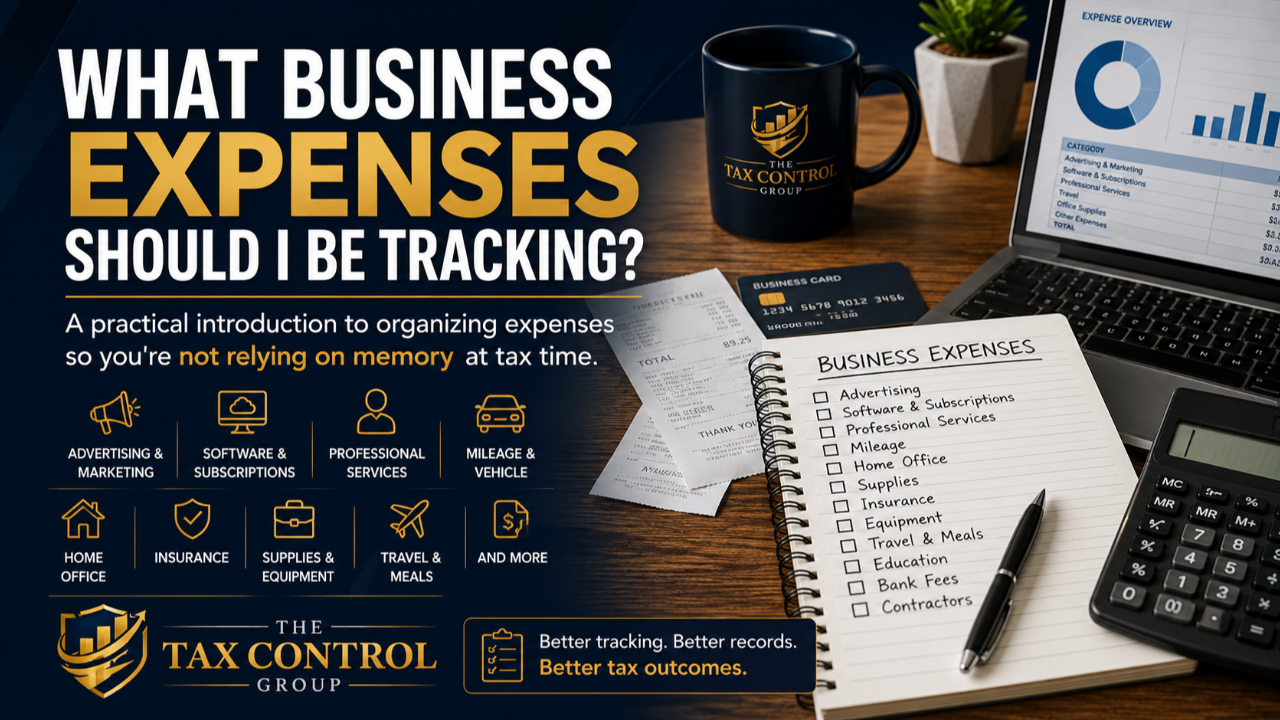
Aug 08, 2026A practical introduction to organizing expenses so you're not relying on memory at tax time.
Running a business means spending money to make money.
Software. Supplies. Advertising. Professional services. Equipment. Mileage. Insurance. Education. Payment-processing fees.
Individually, many of these transactions may seem small. Over an entire year, however, they can add up to a significant part of your business activity.
The problem is that many business owners don't have a consistent system for tracking them.
Instead, tax season arrives and they begin searching through bank statements, credit cards, email receipts, payment apps, and old calendars trying to remember:
“Was this a business expense?”
“What did I buy this for?”
“Did I ever record that?”
“Where is the receipt?”
That is not the ideal time to reconstruct an entire year of business activity.
A better approach is simple:
Track your business expenses while you're actually running your business.
Why Expense Tracking Matters
Expense tracking isn't just about trying to find more deductions.
It helps create an accurate financial record of what is happening inside your business.
The IRS generally allows a business to deduct expenses that are ordinary and necessary in carrying on a trade or business. An ordinary expense is one that is common and accepted in the trade or business, while a necessary expense is one that is helpful and appropriate for it.
But whether a particular expense qualifies depends on the facts and circumstances.
That means the goal shouldn't be:
“How can I turn everything I spend into a deduction?”
The better question is:
“Am I properly identifying and documenting legitimate business expenses as they occur?”
That distinction matters.
Your Tax Control Breakdown™ already identifies missed deductions and poor expense categorization as areas where business owners may be losing tax efficiency.
Let's look at some of the expense categories that deserve your attention.
1. Advertising and Marketing
If you're spending money to attract customers or promote your business, make sure those costs aren't disappearing into a general credit-card statement.
Depending on the circumstances, this category might include things such as:
- online advertising
- website-related costs
- printed marketing materials
- promotional materials
- social media advertising
- email marketing services
- business cards
- certain sponsorship or promotional costs
If you're paying for marketing every month, those expenses should be consistently identified and categorized.
2. Software and Business Subscriptions
Modern businesses can accumulate a surprising number of recurring subscriptions.
Think about the tools you use to operate your business.
You may be paying for:
- bookkeeping software
- customer relationship management software
- scheduling platforms
- cloud storage
- website platforms
- design software
- video conferencing
- project-management tools
- industry-specific applications
- cybersecurity or technology services
A $20 or $50 monthly subscription may not feel significant when it hits your account.
But recurring expenses multiply.
This is one reason your existing Tax Control Breakdown™ specifically tells business owners to begin tracking subscriptions.
3. Office Supplies and Business Supplies
Depending on your business, you may regularly purchase supplies necessary for your operations.
That could include items such as:
- paper
- printer supplies
- postage
- shipping supplies
- notebooks
- business forms
- cleaning or operational supplies
- materials used to provide your services
The specific expenses will vary considerably from one business to another.
That's why categorization matters.
A construction company, consulting firm, salon, medical practice, and online retailer will not have identical expense profiles.
Your records should reflect your actual business.
4. Professional Services
Are you paying other professionals to help operate or support your business?
Track those payments.
Examples can include fees paid for services such as:
- accounting
- bookkeeping
- tax preparation
- legal services
- consulting
- payroll processing
- information technology
- other professional business services
Don't wait until tax season to try to remember whom you paid during the year.
5. Business Insurance
Insurance is another category that can easily become buried among recurring payments.
Depending on your business, you may have expenses associated with different types of business insurance.
The important point from a tracking perspective is straightforward:
Keep business insurance payments identifiable and separate from personal insurance expenses.
The tax treatment of a specific insurance expense depends on the type of coverage and circumstances, so proper classification is important.
6. Equipment and Business Purchases
Did you purchase a computer?
Furniture?
Tools?
Machinery?
Specialized equipment?
Other property for the business?
Track it.
Your Tax Control Breakdown™ specifically identifies equipment purchases as something business owners should begin tracking immediately.
But there's another important point here:
Don't automatically treat every equipment purchase the same way as an ordinary recurring expense.
The tax treatment of business property can depend on the type of asset, cost, business use, timing, depreciation rules, and other factors.
Good tracking gives your tax professional the information needed to determine the appropriate treatment.
7. Vehicle and Mileage Activity
This is an area where waiting until tax season can create major recordkeeping problems.
If you use a vehicle for qualifying business purposes, begin keeping contemporaneous records of that activity.
Your Tax Control Breakdown™ specifically identifies mileage as an area business owners should track.
A mileage record should be created throughout the year rather than reconstructed from memory months later.
Depending on the method and circumstances involved, additional vehicle expense information may also be relevant.
Most importantly:
Don't assume every mile you drive because you own a business is automatically a deductible business mile.
Business use, commuting, and personal use can receive different tax treatment.
8. Home Office Information
Your Tax Control Breakdown™ also tells business owners to begin tracking home office usage.
If you operate your business from home, maintain information that can help determine whether you qualify for a home-office deduction and, if so, how it should be calculated.
Simply working from your house occasionally does not automatically establish that every household expense becomes a business deduction.
Specific requirements apply.
This is another area where maintaining accurate information throughout the year makes the eventual tax analysis easier.
9. Education and Professional Development
Business owners frequently spend money improving their knowledge and skills.
Depending on the facts and applicable tax rules, potentially relevant expenditures may include:
- professional education
- industry conferences
- seminars
- continuing education
- certain professional publications
- certain training programs
Don't assume every educational purchase is deductible simply because you own a business.
Instead, track and describe the expense accurately so its proper treatment can be evaluated.
10. Travel and Meals
Business travel and meals can require more careful documentation than simply finding a charge on your credit-card statement.
If you're incurring these expenses, records may need to establish information such as the:
- amount,
- date,
- location,
- business purpose,
- and business relationship involved.
Rules and limitations can vary by expense.
The important lesson is that a bank statement showing that money was spent does not necessarily establish why it was spent.
Document the business purpose while you still remember it.
11. Bank and Payment-Processing Fees
Small fees are easy to overlook.
Depending on your business and circumstances, you may encounter:
- business bank fees
- merchant-processing fees
- payment-platform fees
- transaction charges
- other costs associated with receiving customer payments
A business processing a large number of transactions may accumulate meaningful costs over the course of a year.
Make sure they're being captured in your bookkeeping rather than disappearing into net deposits.
12. Contractors and Other Business Labor
If you pay people who aren't employees to perform services for your business, those payments need to be properly recorded.
Good records become particularly important because certain payments can also create information-reporting responsibilities.
Don't wait until January to begin figuring out:
Who did I pay?
How much did I pay them?
How were they classified?
Those records should be maintained during the year.
The Bigger Problem: Your Expenses May Be Everywhere
This is where expense tracking often breaks down.
Imagine that you purchase software using one credit card.
You buy supplies using another.
You pay a business expense through a personal account.
You reimburse yourself for something else.
You pay a contractor through a payment app.
You purchase equipment from your business checking account.
Then tax season arrives.
Your accountant isn't looking at one clean financial picture.
They're looking at fragments.
And you're trying to reconstruct the story.
This is exactly why your Tax Control materials emphasize a structured deduction system rather than relying on scattered records.
Separate Business and Personal Activity
One of the simplest improvements you can make is maintaining clearer separation between business and personal transactions.
Your Tax Control intake process specifically asks business owners whether business and personal expenses are completely separated because this is an important indicator of the quality of the underlying records.
When possible, use dedicated business financial accounts for business activity and maintain records that clearly identify the purpose of transactions.
This doesn't determine deductibility by itself.
It makes your records much easier to understand, maintain, and review.
Don't Just Save Receipts. Build a System.
A folder full of receipts is better than no records.
But that's not necessarily an expense-tracking system.
Your system should allow you to answer questions such as:
What was purchased?
When was it purchased?
How much did it cost?
What business purpose did it serve?
Which category does it belong to?
Where is the supporting documentation?
You should be able to answer those questions without conducting an archaeological expedition through twelve months of email.
A Simple Monthly Expense Routine
You don't need to wait until tax season.
Create a recurring monthly process.
At least once each month:
- Review your business bank and credit-card activity.
- Identify and properly categorize business transactions.
- Review receipts and supporting documentation.
- Record mileage and other activity requiring additional documentation.
- Investigate transactions you don't recognize while they're still fresh.
- Review whether business expenses accidentally went through personal accounts.
- Check recurring subscriptions and business services.
- Reconcile your records to the relevant financial accounts.
This is much easier than trying to reconstruct everything once a year.
Expense Tracking Is Only One Part of Tax Control
There's an important limitation to understand.
Better expense tracking does not automatically mean your entire tax situation is under control.
Your Tax Control Breakdown™ identifies three recurring issues:
1. No structured deduction system
2. No quarterly planning
3. No clear financial strategy
Expense tracking primarily helps address the first issue.
You still need to understand what's happening with your income, estimated taxes, tax position, business structure, and year-end planning.
That's why collecting receipts isn't the same thing as having a tax strategy.
Start With the Five Areas You're Most Likely to Forget
If your current system isn't organized, don't make this complicated.
Your Tax Control Breakdown™ gives business owners five practical areas to begin tracking:
Mileage
Home office usage
Subscriptions
Business expenses
Equipment purchases
Start there.
Then build a system that captures the other legitimate expenses associated with operating your particular business.
The goal is to reach tax season with organized records—not memories.
Stop Reconstructing Your Business at Tax Time
Tax season shouldn't begin with:
“Let me see what I can remember.”
By then, you've potentially had hundreds or thousands of transactions.
Instead, create a process that captures what's happening as it happens.
That gives you better records.
Better records give you better information.
And better information makes it easier to understand what's actually happening with your business and taxes.
That's a foundational part of Tax Control.
Want to See Where Your Tax System May Be Breaking Down?
Get The Tax Control Breakdown™ and learn about the recurring gaps that can cause business owners to lose visibility and reach tax season without understanding why they owe.
Get the Free Tax Control Breakdown™
Understand your taxes. Know what needs attention. Take control.
Educational information only. Whether a particular expense is deductible depends on applicable tax law and the taxpayer's individual facts and circumstances. This article does not constitute individualized tax, legal, accounting, or financial advice.
Don't miss a beat!
New moves, motivation, and classes delivered to your inbox.
We hate SPAM. We will never sell your information, for any reason.