Why Waiting Until Tax Season Creates Problems. Read Article →
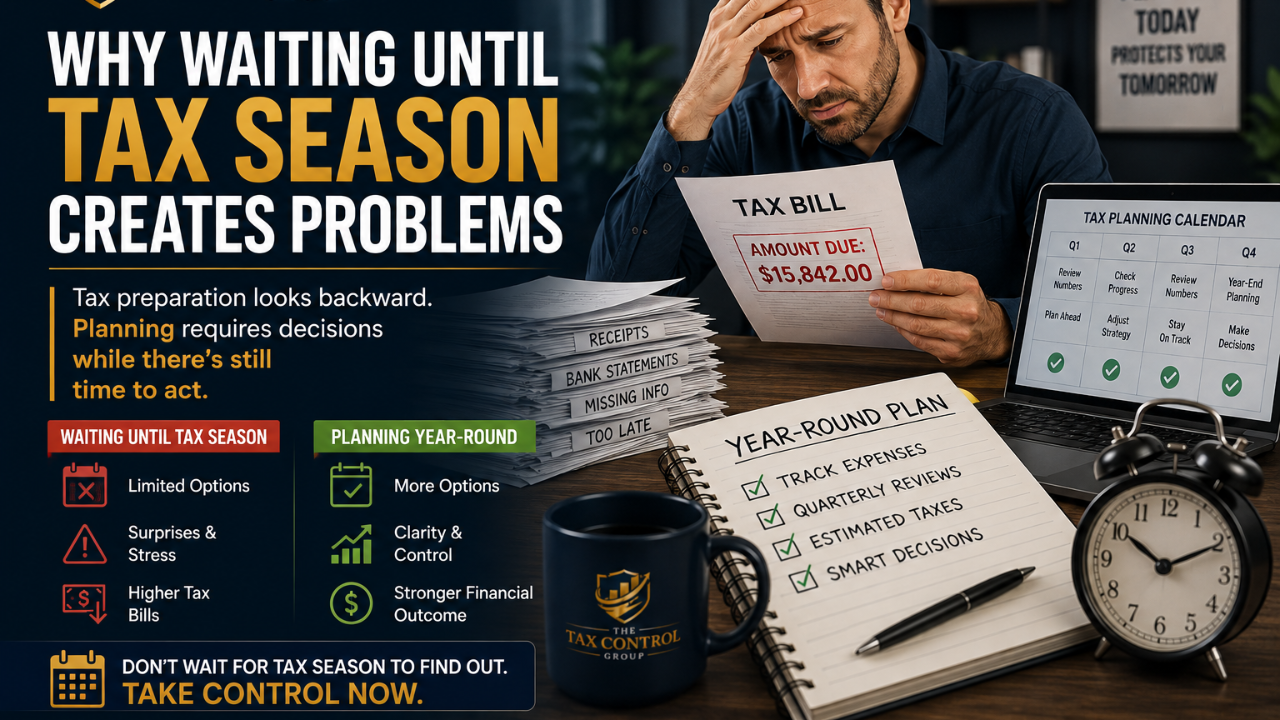
Aug 08, 2026Tax preparation looks backward. Planning requires decisions while there's still time to act.
For many business owners, taxes follow the same annual routine.
The year ends.
Tax documents begin arriving.
You gather your records.
You send everything to your tax professional.
Your return is prepared.
Then you find out what you owe.
If the number is higher than expected, the natural question is:
“What can I do to lower it?”
But there is a problem.
By the time you're preparing last year's tax return, last year is already over.
Many of the business and tax decisions that could have been evaluated during that year may no longer be available—or may have significantly fewer options.
That is one of the biggest problems with waiting until tax season to start thinking about taxes.
Tax preparation tells you what happened. Tax planning gives you an opportunity to make informed decisions while there's still time to act.
Tax Preparation and Tax Planning Serve Different Purposes
Tax preparation is essential.
Your return must accurately report what occurred during the tax year based on applicable tax law and your particular circumstances.
But tax preparation is primarily retrospective.
It looks backward at activity that has already occurred:
- how much income was earned,
- what expenses were incurred,
- what payments were made,
- what tax documents were issued,
- what elections or transactions occurred,
- and what the resulting tax liability may be.
Planning is different.
Planning asks:
What is happening now?
Where are we headed?
What should be evaluated before the year ends?
That's an important distinction.
If your only tax strategy begins after December 31, you're asking your tax professional to analyze a year that has already closed.
The Tax-Season Cycle
Without year-round planning, business owners can easily fall into a repeating cycle:
Earn → Spend → File → Owe → Pay → Repeat
The business makes money.
Expenses occur throughout the year.
Little or no tax analysis happens along the way.
Then the return is prepared and the owner discovers the result.
The following year, the same process happens again.
Your Tax Control Breakdown™ identifies no quarterly planning as one of the three recurring reasons business owners may continue experiencing tax problems year after year.
The issue isn't necessarily the preparation of the return.
The issue may be everything that didn't happen before the return was prepared.
1. You Don't Know Where You're Headed
Imagine driving for an entire day without checking your fuel gauge.
You might make it to your destination.
Or you might discover the problem after the warning light comes on.
Taxes can work similarly.
If your business is profitable but no one is reviewing your financial activity from a tax perspective during the year, you may have very little visibility into your expected tax position.
You know what the business is earning.
You may know what's in the bank.
But you may not know:
What does this mean for taxes?
That's a dangerous gap between business performance and tax awareness.
2. Your Income Can Change During the Year
Businesses don't always earn the same amount every month.
Maybe you started the year expecting $100,000 in profit.
Then business took off.
By midyear, your projected profit is significantly higher.
That's good news.
But it can also change your expected tax picture.
If your income changes while your tax strategy remains unchanged, you can arrive at tax season with a much larger liability than you anticipated.
Waiting until the return is prepared means you may not discover the mismatch until months after the income was earned.
Planning gives you opportunities to periodically ask:
Has anything changed?
And if it has:
What does that mean for my taxes?
3. Estimated Tax Payments May Need Attention
For many business owners, taxes aren't automatically withheld in the same way they typically are from an employee's paycheck.
That makes estimated tax planning particularly important.
If you're making estimated payments based on an outdated income assumption—or not making appropriate payments at all—you may be building a future tax obligation throughout the year.
By tax season, you're seeing the accumulated result.
A year-round process gives you opportunities to evaluate whether your payment strategy still makes sense based on what's actually happening.
Your Tax Control intake process specifically asks whether a business owner makes quarterly estimated tax payments because it is an important part of understanding the client's current tax-control situation.
4. Expense Problems Become Harder to Fix
Think about a business purchase you made ten months ago.
Do you remember exactly what it was for?
Could you locate the receipt?
Could you explain the business purpose?
Now multiply that problem by hundreds of transactions.
Waiting until tax season can turn expense tracking into a reconstruction project.
You may be searching:
- bank statements,
- credit-card accounts,
- email receipts,
- payment applications,
- mileage records,
- calendars,
- invoices,
- and old messages.
And sometimes you're simply trying to remember.
That's why your Tax Control materials emphasize maintaining a structured deduction system rather than trying to rebuild business activity after the fact.
Good tax planning starts with good information.
5. Some Decisions Are Time-Sensitive
One of the most important concepts for business owners to understand is that tax planning is often connected to timing.
Different tax strategies have different requirements, deadlines, eligibility rules, and consequences.
Some actions must occur during the applicable tax year to produce the intended result.
Others may have deadlines extending beyond year-end.
The exact treatment depends on the strategy and the taxpayer's circumstances.
That is why a tax professional should evaluate the specific situation rather than relying on generic year-end tax tips.
The important principle is:
You have more planning opportunities while the year is still happening than you do after every transaction has already occurred.
6. Major Business Decisions Can Have Tax Consequences
Business owners make decisions throughout the year that may affect their taxes.
For example:
- purchasing equipment,
- hiring workers,
- changing compensation,
- taking money from the business,
- selling business property,
- making retirement-plan decisions,
- expanding operations,
- changing ownership,
- restructuring debt,
- or considering a different tax election.
These decisions shouldn't necessarily be made solely because of taxes.
A tax deduction does not automatically make a bad business purchase a good one.
But significant business decisions can have tax consequences.
Ideally, those consequences should be understood before the decision is finalized whenever possible.
7. Your Business Structure Shouldn't Be Ignored
Business owners often choose a structure when they start their business and then never revisit it.
But businesses change.
Revenue changes.
Profit changes.
Ownership can change.
The owner's role can change.
A structure or tax treatment that made sense at one stage may deserve reevaluation at another.
That doesn't mean you should automatically change entities or make a particular tax election.
It means the issue should be evaluated based on your actual circumstances.
Waiting until tax season may turn what should have been a proactive discussion into another question about what already happened.
8. Cash Flow and Taxes Can Become Disconnected
Here's another common problem.
Your business earns money throughout the year.
You use the cash to:
- operate the business,
- pay employees or contractors,
- make purchases,
- cover personal needs,
- invest in growth,
- and handle other obligations.
Then tax season arrives.
You discover that you owe taxes—but the cash generated during the year has already been spent.
This is one reason a profitable business can still experience serious tax-related cash-flow pressure.
The problem isn't necessarily that the business didn't make money.
The problem may be that no system existed to anticipate and prepare for the tax obligation associated with that money.
Tax Planning Isn't About Making Random Purchases in December
There's an important misconception worth addressing.
Tax planning doesn't mean reaching December and asking:
“What can I buy so I don't have to pay taxes?”
Spending $1 solely to avoid paying tax on $1 generally doesn't make economic sense.
Effective planning should consider both the tax consequence and the business consequence.
The goal is not to eliminate taxes at any cost.
The goal is to make informed, compliant decisions using the information available while meaningful choices can still be evaluated.
What Should Happen During the Year?
A stronger tax-control process involves regular checkpoints rather than one annual surprise.
Depending on the business and the level of service involved, a year-round review may consider questions such as:
How is the business performing compared with expectations?
Has projected income changed?
Are expenses being properly captured and categorized?
Are business and personal transactions properly separated?
Are estimated tax payments aligned with the current situation?
Are there significant transactions coming up?
Are there decisions that should be evaluated before year-end?
Does the owner understand the current tax position?
The objective is visibility.
You want to know what's happening while you still have an opportunity to respond appropriately.
Quarterly Planning Creates Checkpoints
You don't need to think about taxes every day.
But you also shouldn't necessarily ignore them for eleven months.
Quarterly reviews create natural checkpoints during the year.
For example, a review can help determine whether actual business performance is tracking differently from earlier expectations and whether the tax picture needs further analysis.
Your Tax Control Breakdown™ specifically identifies the absence of quarterly planning as one of the three recurring gaps that can keep business owners stuck in the same tax cycle.
That is why Tax Control is designed to move the conversation beyond annual filing.
The Difference Between Knowing and Controlling
Consider two business owners.
Both make similar profits.
Both eventually have accurate tax returns prepared.
But the first owner doesn't discuss taxes until filing season.
The second owner reviews the business throughout the year, maintains organized records, evaluates estimated payments, and discusses significant decisions before year-end.
Both may ultimately owe taxes.
Tax control does not mean guaranteeing that you will owe nothing.
The difference is that the second owner is more likely to understand the developing situation before the final return is prepared.
That visibility can improve planning and reduce surprises.
Don't Judge Your Tax Strategy Only by Whether You Receive a Refund
A refund isn't automatically evidence of excellent tax planning.
And owing money isn't automatically evidence of poor tax planning.
The real question is whether the result was understood and appropriately planned for.
A business owner who expects to owe $15,000 and has intentionally prepared for that obligation is in a very different position from someone who unexpectedly discovers a $15,000 balance when the return is completed.
Tax control is about creating more clarity before the deadline arrives.
A Simple Tax-Control Calendar
Instead of thinking about taxes only during filing season, divide the year into checkpoints.
Throughout the year:
Maintain accurate books, receipts, mileage records, and supporting documentation.
Quarterly:
Review business performance, projected income, estimated tax considerations, and major changes.
Before year-end:
Evaluate time-sensitive planning opportunities and upcoming business decisions.
During tax preparation:
Use organized, complete information to accurately prepare the return and review the outcome.
Then the return becomes the conclusion of a year-round process—not the first time anyone seriously examines the tax situation.
Preparation Looks Backward. Control Looks Forward.
Tax preparation answers:
“What happened?”
Tax planning asks:
“What is happening, where are we headed, and what should we consider while there's still time?”
Both matter.
But they are not the same service.
Your broader Tax Control framework is intentionally structured around:
Stabilize → Reconstruct → Control
and your Tax Clarity Report is designed to explain what is happening, why it is happening, what deserves priority, and what should happen next.
That is the shift from reacting to tax season to creating a system for managing taxes throughout the year.
Don't Wait for the Tax Return to Tell You There's a Problem
If you repeatedly reach tax season surprised by what you owe, the solution may not be another last-minute tax tip.
You may need to change when you're paying attention.
Start earlier.
Track consistently.
Review periodically.
Plan before deadlines.
And use tax preparation for what it is designed to do: accurately report the year that already happened.
Want to Know Where Your Tax System May Need Attention?
Get The Tax Control Breakdown™ and learn about the recurring gaps that can leave business owners reacting to taxes instead of planning for them.
Get the Free Tax Control Breakdown™
Understand your taxes. Know what needs attention. Take control.
Educational information only. Tax planning opportunities, deadlines, deductions, elections, estimated-tax requirements, and other tax consequences depend on applicable law and each taxpayer's individual facts and circumstances. This article does not constitute individualized tax, legal, accounting, or financial advice.
Don't miss a beat!
New moves, motivation, and classes delivered to your inbox.
We hate SPAM. We will never sell your information, for any reason.