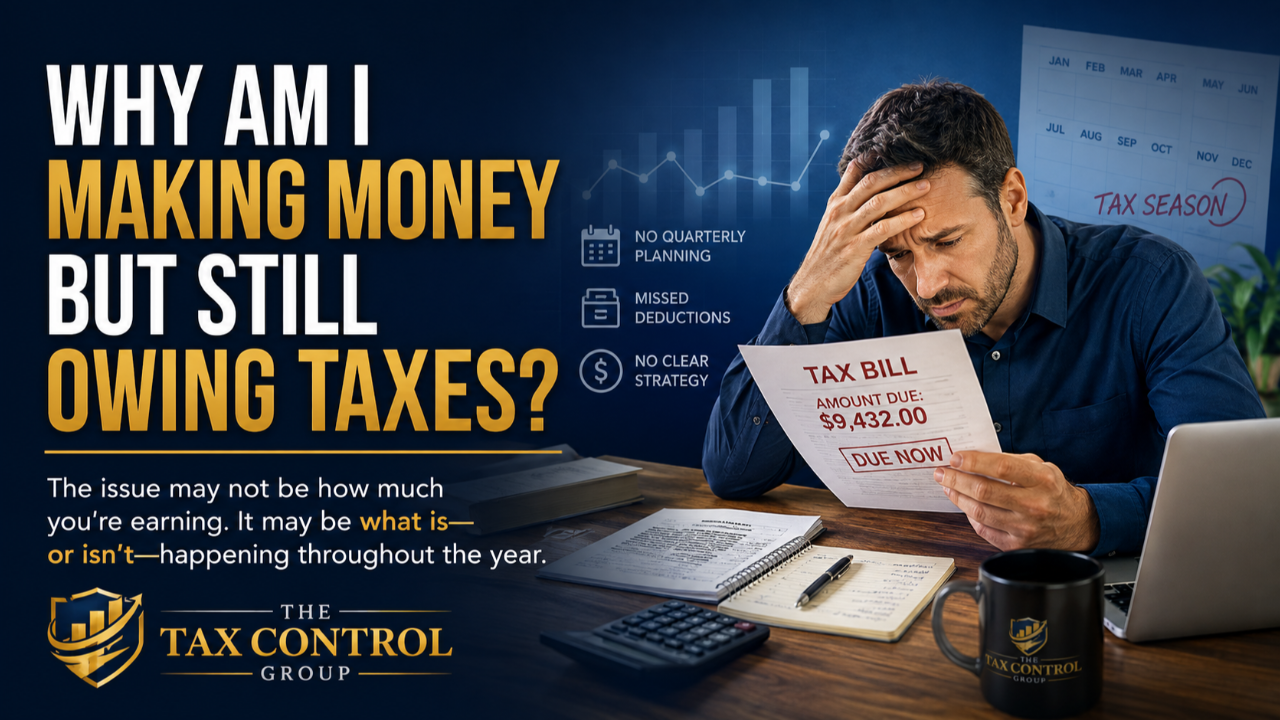
Why Am I Making Money but Still Owing Taxes? Read Article →
Aug 08, 2026Why Am I Making Money but Still Owing Taxes?
Your business is making money.
Revenue is coming in. Clients are paying. The business may even be having its best year yet.
So why does tax season keep ending with the same frustrating question?
“If I'm making good money, why do I still owe so much in taxes?”
For many business owners, the answer isn't simply that they're earning too much.
The bigger issue may be what is—or isn't—happening throughout the year.
Taxes are often treated like an annual event: gather the records, prepare the return, find out what you owe, and figure out how to pay it.
But by the time you reach that point, most of the year is already over.
That's the difference between tax preparation and tax control.
And understanding that difference can change the way you look at your entire tax situation.
Making Money and Being Prepared for Taxes Are Two Different Things
A profitable business can still have a tax problem.
Why?
Because earning money doesn't automatically create a system for handling the tax consequences of earning that money.
Imagine this:
Your business brings in revenue throughout the year.
That money gets used to:
- pay operating expenses,
- cover payroll or contractors,
- purchase equipment,
- pay personal bills,
- reinvest in the business,
- and compensate you as the owner.
The business may look successful.
But if no one is regularly evaluating the tax impact of what's happening, you can reach tax season and discover that the amount due is far larger than the cash you've actually kept available.
That's when many owners begin wondering:
“Where did all the money go?”
That question is important.
But an even better question is:
“What was happening throughout the year that caused me to arrive at this result?”
That is where Tax Control begins.
1. You May Be Waiting Until Tax Season to Think About Taxes
One of the most important differences between filing taxes and controlling taxes is timing.
Tax preparation generally looks backward.
It tells you what happened.
Tax planning looks forward.
It gives you an opportunity to understand what's happening before the year is over.
If the first serious tax conversation you have each year happens when your return is being prepared, there may be very little time left to change the underlying activity that produced the result.
That's why the same pattern can repeat:
Earn → Spend → File → Owe → Pay → Repeat.
The problem isn't necessarily that your tax return was prepared incorrectly.
The problem may be that there was never a year-round process designed to help you anticipate the outcome.
Your existing Tax Control Breakdown™ identifies no quarterly planning and no clear financial strategy as two of the recurring gaps that can contribute to this pattern.
2. Your Expense Records May Not Tell the Complete Story
Business owners frequently tell themselves:
“I have plenty of write-offs.”
That may be true.
But having business expenses and having properly identified, documented, categorized, and supportable deductible expenses are not necessarily the same thing.
Throughout a busy year, expenses can become scattered across:
- business checking accounts,
- personal accounts,
- multiple credit cards,
- payment apps,
- online subscriptions,
- recurring software charges,
- mileage and vehicle activity,
- travel,
- equipment purchases,
- and other business transactions.
When those records aren't maintained consistently, tax season can become an exercise in reconstruction.
And memory isn't a reliable accounting system.
Your Tax Control framework specifically identifies missed deductions and poor expense categorization as potential areas where business owners may be losing tax efficiency.
This does not mean every expense is deductible or that finding additional expenses will automatically reduce someone's tax bill by a particular amount.
It means your records need to accurately reflect the legitimate activity of the business so the return can be prepared using complete, supportable information.
3. Bookkeeping and Tax Planning Are Not the Same Thing
This distinction causes a lot of confusion.
You can have bookkeeping and still lack tax control.
You can have QuickBooks.
You can receive financial statements.
You can reconcile the bank account every month.
And you can still reach tax season completely surprised by what you owe.
That's because bookkeeping primarily records and organizes what has already happened.
Tax planning asks different questions.
For example:
What does the current profit level mean for taxes?
Are estimated payments keeping pace with the expected liability?
Are business and personal transactions being properly separated?
Are records sufficiently organized to support legitimate deductions?
Are there tax decisions that should be considered before year-end rather than after it?
Good records are essential.
But numbers without interpretation don't necessarily create control.
Your longer Tax Control material makes this same distinction: a business owner may have QuickBooks, spreadsheets, a bookkeeper, or an accountant and still not understand why they owe, which categories deserve attention, or what needs to change before the following year.
4. Your Estimated Tax Payments May Not Match What's Actually Happening
For many business owners, there isn't an employer automatically withholding enough tax from every dollar earned.
That makes estimated tax planning particularly important.
If income or profit changes significantly during the year while estimated payments don't change with it, the eventual tax bill may be very different from what you expected.
Consider the underlying problem:
Your business grows.
Your income increases.
But your tax-payment strategy remains the same.
You may feel financially successful throughout the year while simultaneously building a larger future tax obligation.
Then the return gets prepared.
And suddenly the bill appears.
It may feel like a tax-season problem.
But the underlying issue may have been developing for months.
5. Your Business Structure May Need to Be Evaluated
Another common mistake is assuming that simply forming an LLC automatically creates the most advantageous tax treatment.
It doesn't work that way.
An LLC is a legal structure, while its federal tax treatment depends on factors including the number of owners and any elections that have been made.
Whether another tax treatment or election should be considered requires an individualized analysis.
There is no universal answer.
But as a business grows, its tax structure should not necessarily remain on autopilot simply because that's how the business started.
This is another reason year-round review matters.
The question isn't:
“What's the popular tax strategy?”
It's:
“What is appropriate for this business, this owner, these numbers, and these circumstances?”
6. You May Be Looking at Revenue When Profit Is What Matters
Another source of confusion is the difference between revenue, cash flow, and taxable income.
They are not interchangeable.
A business might generate $200,000 in gross revenue without producing $200,000 of taxable profit.
Likewise, the amount sitting in your bank account doesn't necessarily tell you what your tax liability will be.
That's why statements such as:
“I didn't think I made enough to owe this much”
often signal that the owner needs a clearer understanding of the numbers behind the return.
You shouldn't have to wait until tax season to learn what your business's financial activity may mean for your taxes.
The Real Question Isn't Just “Why Do I Owe?”
If you've owed a substantial amount once, it deserves attention.
If you've owed a substantial amount year after year, the recurring pattern deserves even more attention.
Your Tax Control intake system is deliberately designed to look at exactly these issues: how much the person typically owes, how many years it has happened, whether estimated payments are being made, how expenses are tracked, whether business and personal expenses are separated, and how confident the owner is in their records.
That's because a repeated tax bill usually needs more investigation than:
“How much do I owe this year?”
You want to understand:
Why does this keep happening?
What factors are contributing to it?
Which factors can actually be changed?
What needs attention first?
What should happen differently during the year?
Those questions move you away from reaction and toward control.
A Simple Tax Control Checkup
Ask yourself these five questions:
- Do I know approximately what my tax liability is before my return is prepared?
- Do I review my business income and expenses consistently throughout the year?
- Do I know whether my estimated tax payments are keeping pace with my current situation?
- Can I confidently explain how my business expenses are being captured and categorized?
- Do I have a tax strategy that happens before year-end—not just tax preparation afterward?
If several answers are no or I'm not sure, that doesn't automatically mean you're overpaying taxes.
It does mean there may be areas worth reviewing.
And that's exactly the distinction your Tax Control Breakdown™ is designed to uncover through its self-assessment and review of planning, deductions, and financial strategy.
What Can You Do Right Now?
Don't start by searching the internet for another list of “secret tax deductions.”
Start by improving visibility.
Make sure you're consistently maintaining records for legitimate business activity such as mileage where applicable, subscriptions, equipment and tools, and other recurring business expenses. Your existing Tax Control materials similarly identify these areas as immediate items business owners can begin tracking.
Then go one step further.
Don't just ask:
“What can I deduct?”
Start asking:
“What is my current tax position, and what am I doing during the year to control the eventual outcome?”
That's a much more powerful question.
Preparation Tells You What Happened. Control Helps You Prepare for What Happens Next.
There is nothing wrong with tax preparation.
You need an accurate return.
But if you're a profitable business owner who has owed thousands of dollars repeatedly, filing the return may only address the final step of a much longer process.
You may need to understand what happened before the return was ever prepared.
That's the philosophy behind The Tax Control Group™:
Clarity → Control → Better Decisions
Your master framework describes the Tax Clarity Report as explaining what is happening, why it's happening, the priorities, and the next steps, followed by a Tax Control Plan built around Stabilize → Reconstruct → Control.
That's a fundamentally different conversation from simply asking:
“How much do I owe?”
Ready to Find Out What's Actually Happening?
If you're making money but repeatedly owing more in taxes than you expected, don't assume you simply need another tax tip.
Find the pattern first.
The Tax Control Breakdown™ will help you understand the common reasons business owners repeatedly owe, identify areas that deserve closer attention, and determine what your next step should be.
Get the Free Tax Control Breakdown™
Understand why you owe. Know what needs attention. Start taking control.
Educational information only. Tax treatment depends on each taxpayer's individual facts and circumstances. This article does not constitute individualized tax, legal, or financial advice.
Don't miss a beat!
New moves, motivation, and classes delivered to your inbox.
We hate SPAM. We will never sell your information, for any reason.